
(Image credit: Christie's Images Ltd. 2026)
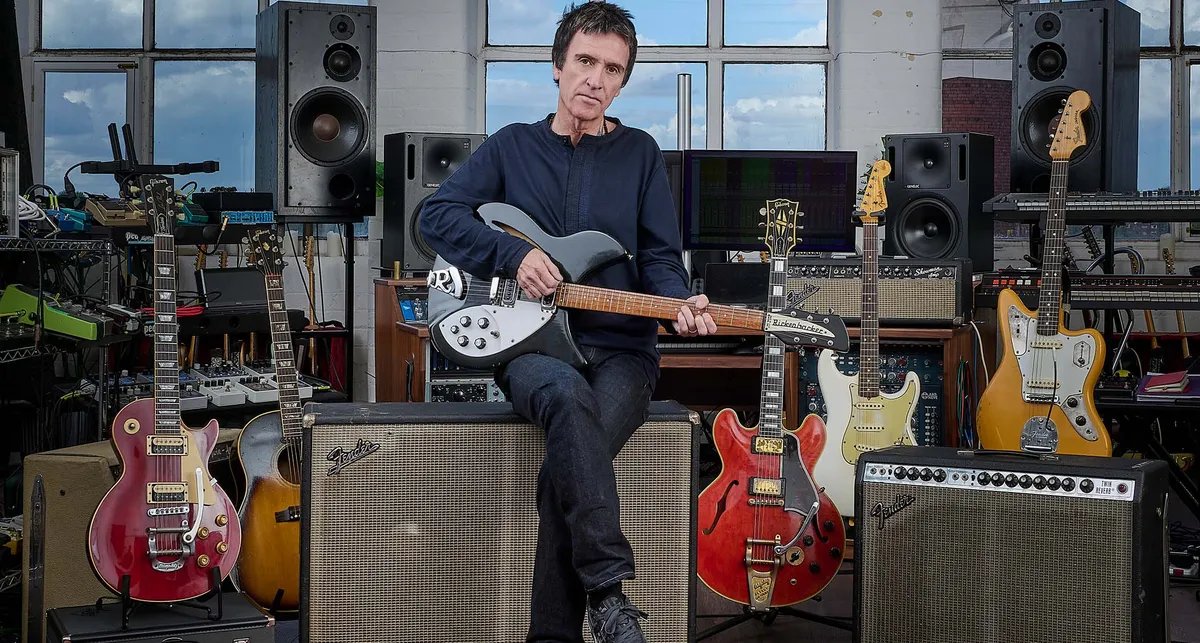
Yesterday, Christie’s sold 111 lots from Johnny Marr’s guitar collection for £3.6 million, more than triple its estimate. Registered bidders came from 34 countries, and 81% of them were new to Christie’s. The headline lot was Marr’s 1982 Rickenbacker 330 Jetglo. Estimated at £60,000 to £80,000, it sold for £358,400. His red 1960 Gibson ES 355 sold for £204,800, while a Johnny Marr Signature Jaguar used on the No Time To Die soundtrack sold for £46,080 against an estimate of £8,000 to £12,000.
It is amazing to see these instruments gather so much interest and love after all these years. On one level, they are guitars. Wood, wire, metal, plastic and electronics. There are other Rickenbacker 330s. There are other ES 355s. They were production instruments, built to a specification and sold to musicians. But Johnny's guitars are not just guitars, if you know what I mean? The Rickenbacker is not simply a black electric guitar made in 1982. It was used extensively during the early years of The Smiths. It is connected to songs, records, tours, photographs and a particular moment in British music. It later passed through Noel Gallagher’s hands during the making of Definitely Maybe and appeared on the sleeve of Supersonic. The physical object has not changed. The context around it has. And that context has value.
What It Means To Me, Personally
I was born in Manchester and grew up in Stockport. Johnny Marr was born in Ardwick, just down the road. That matters to me because, when I was becoming a young man, guitar music was everywhere. I started playing guitar in 1994, when I was eight. I had just come back from a family holiday in America where I heard Jimi Hendrix for the first time and decided I wanted to play. The timing helped. The charts were still culturally important. Oasis versus Blur was happening in real time. Manchester already carried the legacy of The Smiths, New Order, The Stone Roses, Happy Mondays, The Charlatans and other prominent bands, and everything around them. If you were a kid from that area who liked music, it felt as if all of this was happening unusually close to home. Like this was OUR patch, OUR music.
There were guitar shops everywhere. Stockport had several. Manchester had Johnny Roadhouse, Music Ground, Dawsons and others. You could go into town and see instruments you could never afford. Sometimes just knowing they existed, and seeing them in real life a few miles from your house, was enough to carry you away in a dream of aspiration and “one day, i might own that guitar and play it on stage”. Most of that has pretty much gone now. Playing the guitar back then also had social currency. A group of us at school were all learning at the same time. Someone would come in having learnt something new, show it off, and everybody else would go home wanting to catch up. I remember learning this guitar lick and watching one of my mates’ eyes pop out of his head because he had never seen anyone do it before. I can't lie, there was a vague hope that playing guitar might impress girls, but really what happened we became very good guitarists, very quickly because we kept pushing each other.
It also gave us something of our own. We could write songs. We could form a band, call it whatever we wanted and get gigs! Holy shit, this was real! There was something incredibly potent about realising, as a teenager, that you could make something from nothing and put it in front of other people and get a positive reaction. Most of us still play. We grew up, moved away around the world, got jobs and had families, but the guitar stayed. It became a constant companion, a way of returning to the music we love and, sometimes, to the people we used to be. That is part of what Johnny Marr represents to me. Not just The Smiths, but a place, a time and an entire culture around learning, playing and obsessing over guitars. I can still smell the air back then.
What Does Any of This Have to Do With CRM?
A database could describe Marr’s Rickenbacker perfectly accurately as a 1982 Rickenbacker 330, Jetglo, six string electric guitar. That tells us what the object is. It tells us almost nothing about why somebody was prepared to spend £358k on it. Add the history and suddenly the same object means something different. Marr bought it after signing his first publishing deal. He used it during the early Smiths period. It became connected with records, performances and photographs. It later crossed into another generation of Manchester guitar music through Noel Gallagher. The object has not changed. Our understanding of it has.
CRM already does a simpler version of this. We take individual facts and turn them into context. Someone has purchased from the official store three times. Their average order value is £72. They open most campaigns. They have not bought anything for nine months. Taken together, those facts allow us to express a more useful idea: this might be a highly engaged customer with historically strong purchase behaviour who is beginning to lapse. But music gives us another layer, because fandom contains huge amounts of cultural and psychographic context that ordinary transactional data does not always describe very well. Which era matters to this fan? Which album brought them in? Are they a collector? A musician? Are they interested in studio equipment, songwriting, live performance, artwork or archive material? Is an artist connected to the place where they grew up? Are they looking for ownership, access, community, discovery or nostalgia?
You do not need to know all of this about everybody. In fact, trying to capture everything would quickly become unmanageable. The opportunity is to recognise the handful of signals that matter for the goal you are trying to achieve, then use them to add context to both the audience and what you are marketing to them.
An Open Door, Not a Hard Sell
For an artist with a large catalogue, this could be as simple as recognising different types of affinity rather than treating the whole database as one audience. One person might engage most with archive footage and deluxe reissues. Another might stream the hits and occasionally open an email. Another may have bought vinyl repeatedly over several years. Another might consistently engage with one particular period of the catalogue. The point is not to tell everybody that a £150 box set is important and it’s on sale now. It’s to identify the people for whom it might already be important and open the right door for them. To me, that feels different from a hard sell. It is closer to saying: we noticed what you care about, and there is something here you might want to see.
Christie’s did not make Johnny Marr’s collection relevant to everybody. It created an environment in which the people for whom these objects were already intensely relevant could understand the provenance, recognise the significance and act on it. This happened in a finite moment. This was not Johnny Marr’s Rickenbacker, available whenever you fancied it. There was one guitar, one auction and one opportunity. If you wanted it, you had to be there, whether that meant in the room, on the phone or online. The sale lasted for more than five hours. Bidders registered from 34 countries. The collection realised more than triple its estimate in revenue. And possibly the most interesting stat of the whole sale was 81% of registered bidders were new to Christie’s.
The content attracted the audience. Christie’s had something culturally important enough that people who had never registered before, entered its ecosystem specifically for this event. The collection created acquisition, provenance and storytelling created relevance, the auction format concentrated attention into a particular moment, and the audience told Christie’s exactly what those objects were worth to them.
Now I’m assuming that most artists do not have a Rickenbacker worth £358,400 sitting in storage, BUT they do have context around their own story and the objects, people and places that play a role. Records were made somewhere. Songs belong to periods in people’s lives. Artwork has stories and reasoning behind it. Instruments have history: where they've been, who used them, what they were used for and why. Fans arrived through particular albums, gigs, scenes, cities and moments. The catalogue is full of objects, stories and associations whose value changes depending on who is looking at them. CRM gives us an increasingly sophisticated way to identify the people at the other end of those stories.
So perhaps the useful question is not simply, what can we sell to our audience?
It is, what do we know about why this matters to them?